

Convocatoria al XII Congreso Internacional de Investigación REDU 2025
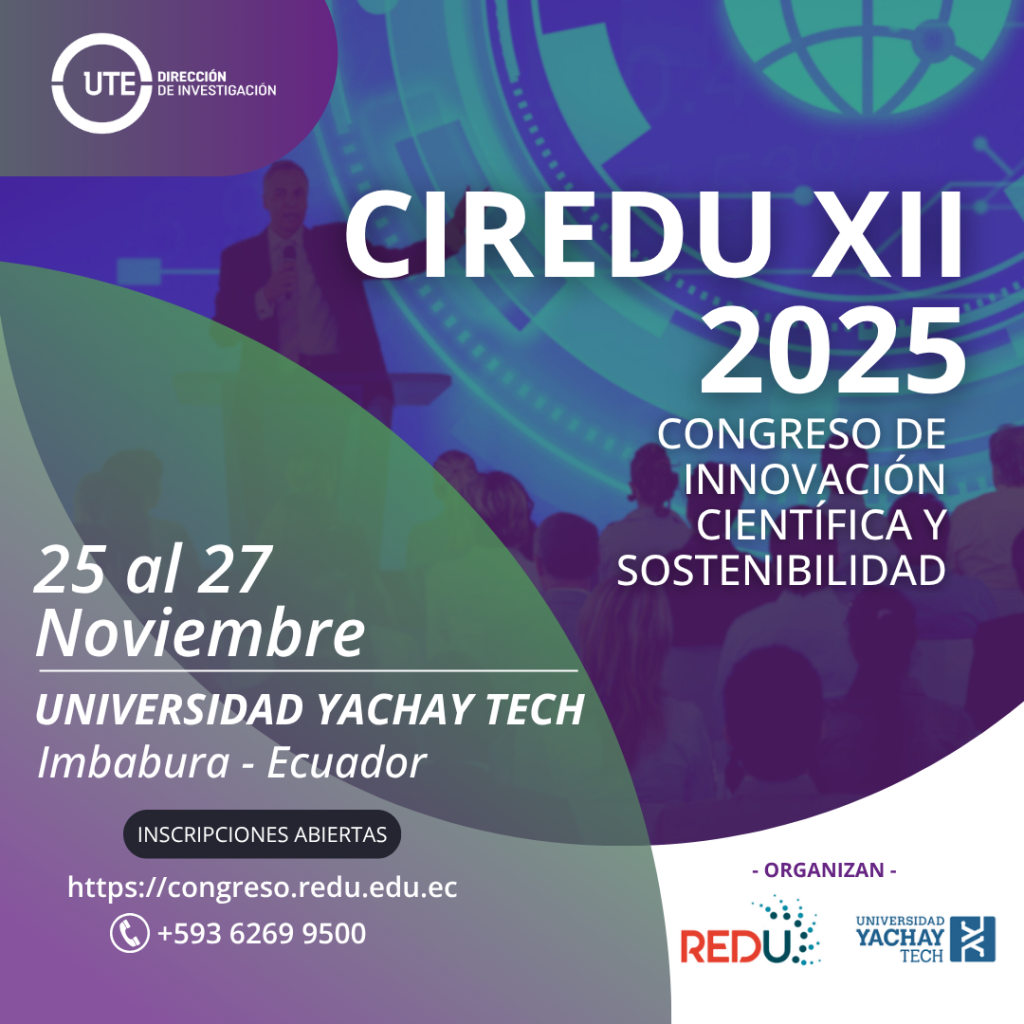
¡Ya está abierta la convocatoria al XII Congreso Internacional de Investigación REDU 2025! Del 25 al 27 de noviembre de 2025, la Universidad Yachay Tech será sede de uno de los encuentros académicos más importantes del país: el XII Congreso Internacional de Investigación REDU 2025, un espacio para compartir conocimiento, innovación y ciencia al servicio del desarrollo sostenible. Este evento reunirá a investigadores, académicos y profesionales de Ecuador y de la región, con el propósito de impulsar soluciones sostenibles desde la ciencia, la tecnología y la innovación. 🌎 Ejes temáticos:🔹 Energía🔹 Tecnología🔹 Ciencias de la vida🔹 Desarrollo territorial sostenible El congreso constituye una plataforma estratégica para visibilizar la producción científica de las universidades, fortalecer redes de colaboración y generar impacto a través del conocimiento. 📍 Lugar: Universidad Yachay Tech📅 Fecha: 25 al 27 de noviembre de 2025📝 Inscripciones abiertas: https://congreso.redu.edu.ec 🙌 Agradecemos su apoyo y compromiso con el fortalecimiento de la investigación en la educación superior ecuatoriana.
Neurobrucelosis que se manifiesta como hemiparkinsonismo secundario en un técnico veterinario: Informe de un caso y revisión basada en evidencia

Encuentra más información en nuestro repositorio digital La neurobrucelosis es una complicación grave de la brucelosis, que se presenta en el 3%–10% de los casos sistémicos. Los trastornos del movimiento, en particular el parkinsonismo, son manifestaciones poco frecuentes que presentan importantes dificultades diagnósticas y suelen estar asociadas a la exposición ocupacional. Presentación del caso: Presentamos el caso de un técnico veterinario de 51 años que desarrolló hemiparkinsonismo derecho progresivo durante dos años, acompañado de síntomas sistémicos como fiebre, pérdida de peso y artralgia. El diagnóstico se estableció mediante los hallazgos característicos en el líquido cefalorraquídeo (LCR) de pleocitosis linfocítica, serología positiva en LCR y suero para Brucella, y confirmación molecular definitiva con una reacción en cadena de la polimerasa (PCR) positiva en LCR para el ADN de Brucella. La tomografía computarizada por emisión monofotónica del transportador de dopamina (DaT-SPECT) reveló un patrón atípico de déficit dopaminérgico nigroestriatal, lo que apoya una causa secundaria. El paciente recibió tratamiento con un régimen antibiótico triple basado en ceftriaxona durante seis meses y levodopa/carbidopa sintomática. Esto resultó en la resolución de los síntomas sistémicos y una recuperación funcional significativa, con características parkinsonianas residuales leves a los 24 meses de seguimiento. Conclusiones: Este caso destaca la neurobrucelosis como un diagnóstico diferencial crítico para el parkinsonismo atípico, especialmente en pacientes con antecedentes relevantes de exposición ocupacional o ambiental. El diagnóstico temprano mediante pruebas serológicas y moleculares exhaustivas, seguido del inicio inmediato de protocolos antibióticos basados en la evidencia, puede mejorar sustancialmente los resultados clínicos. Este informe subraya la importancia de implementar medidas estrictas de seguridad laboral para prevenir esta infección zoonótica debilitante. Accede al artículo completo aquí
Calidad y sesgo en ensayos controlados aleatorizados Published in Latin American Nursing Journals: A Meta-Epidemiological Study

Encuentra más información en nuestro repositorio digital Los ensayos aleatorizados controlados (ECR) son esenciales para la atención de enfermería basada en pruebas. Sin embargo, la calidad de los informes y el cumplimiento de las normas metodológicas en las revistas de enfermería latinoamericanas sigue siendo incierta. Este estudio evalúa las características, la calidad de los informes y el riesgo potencial de sesgo de los ECR publicados en revistas de enfermería latinoamericanas. Objetivo: Evaluar el cumplimiento de informes y el riesgo de sesgo de los ECR publicados en revistas de enfermería latinoamericanas. Diseño: Estudio de meta-investigación. Métodos: Se realizó una búsqueda exhaustiva de 29 revistas latinoamericanas de enfermería, cubriendo publicaciones del 2000 al 2024. Los ECA identificados se evaluaron para determinar la adhesión a las directrices de presentación de informes de CONSORT y se evaluó el riesgo de sesgo. Los resultados se clasificaron utilizando la taxonomía COMET. Se realizó un análisis descriptivo. Resultados: Se seleccionaron un total de 6377 referencias, identificando 34 ECR elegibles, la mayoría publicados después de 2018. La mediana de cumplimiento del CONSORT fue de 19 ítems reportados (IQR 16-22). Se observó un alto grado de cumplimiento (> 90%) en los temas de informes abstractos, los objetivos del estudio y los criterios de selección de participantes. Sin embargo, las características metodológicas críticas como los procedimientos de aleatorización, cegamiento y registro del protocolo mostraron una baja adherencia (< 40%). El riesgo de sesgo se calificó sobre todo como «algo preocupante», debido en gran parte a la insuficiencia de los informes. Según la taxonomía COMET, los dominios de resultados más frecuentemente comunicados fueron «Prestación de cuidados» y «Funcionamiento físico». Conclusiones: Los informes de cumplimiento y el riesgo de sesgo de las ECA publicadas en revistas de enfermería latinoamericanas presentan lagunas significativas, particularmente en áreas metodológicas clave. Estas deficiencias dificultan la transparencia, la reproducibilidad y la integración en la síntesis de pruebas. El fortalecimiento de las políticas editoriales y la aplicación de normas de presentación de informes podría mejorar la calidad y la fiabilidad de las investigaciones publicadas en revistas de enfermería latinoamericanas. Accede al artículo completo aquí
Differential impact of coffee quantity and sweetening on body composition parameters and inflammation

https://bit.ly/3JcLc0y Coffee is the most consumed and popular beverage worldwide. The health benefits of its regular, moderate consumption are well known, and include antioxidant and anti-inflammatory effects, as well as metabolic effects, reducing the risk of obesity and related diseases. The available literature, however, provides no information about the effect of coffee consumption on body composition (BC) and inflammation. The present cross-sectional observational study aims to investigate the effect of coffee consumption on BC and inflammation-related parameters, as well as the possible impact of adding sugar and the frequency of consumption. Methods: Coffee consumption habits, preference for adding sugar and frequency of daily consumption were assessed in 2,556 adults (1,080 men and 1,476 women). BC was assessed using Bioelectrical Impedance Analysis (BIA), whilst high-sensitivity C-reactive protein (hs-CRP) levels were monitored for inflammatory status. Results: A total of 1,855 subjects (680 men and 1,175 women) were included in the statistical analysis. Compared to non-consumers, coffee consumers showed lower body mass index (BMI), waist girth (WG), and hs-CRP levels, and higher skeletal muscle mass (SMM), appendicular SMM (ASMM), phase angle (PhA), and standardised PhA (SPA) (p < 0.001 for all). The same trend was observed for unsweetened coffee consumers compared to subjects consuming sweetened coffee. With increasing coffee consumption, BMI, WG, and hs-CRP generally decreased, whilst SMM and ASMM showed a bell-shaped trend with peak values in those consuming 2–3 cups per day. Similarly, PhA and SPA values were highest among moderate coffee consumers. Conclusion: These findings suggest that moderate coffee consumption, particularly unsweetened coffee, is associated with more favourable body composition and inflammatory profiles. Given the observational design, causality cannot be established. Nevertheless, the results may inform dietary guidance aimed at supporting muscle maintenance and mitigating obesity-related metabolic risk. https://doi.org/10.3389/fnut.2025.1673677
Actitudes de la atención médica hacia la depresión en América Latina: un análisis de clase latente de Argentina, Chile, Ecuador, Perú y Venezuela utilizando el cuestionario revisado de actitud hacia la depresión (SR-DAQ)

Encuentra más información en nuestro repositorio digital Antecedentes: La depresión afecta significativamente a los sistemas de salud en todo el mundo, particularmente en América Latina, donde la estigmatización cultural y las ideas erróneas sobre la salud mental disuaden a las personas de buscar ayuda. Las actitudes de los profesionales de la salud hacia la depresión pueden afectar su prevención, diagnóstico y tratamiento. Objetivo: Categorizar las actitudes de los profesionales de la salud latinoamericanos hacia el diagnóstico y manejo de la depresión en subgrupos utilizando el Spanish-validated Revised Depression Attitude Questionnaire (SR-DAQ). Métodos: Un estudio transversal encuestó a 2,409 profesionales utilizando SR-DAQ de 2019 a 2022. El análisis de clases latentes y la regresión logística multinomial se utilizaron para identificar las clases de actitud y explorar las influencias demográficas. Resultados: Entre nuestra muestra, se identificaron cuatro clases de actitud: Escépticos de la depresión (21%), Cautelosos de la depresión (33%), Neutrales de la depresión (18%) y Defensores de la depresión (28%). El género y la subespecialidad médica influyeron significativamente en la composición de las clases, con más probabilidades de que mujeres y especialistas en salud mental formen parte de los Defensores. Conclusión: El estudio revela actitudes variadas hacia la depresión entre los profesionales de la salud latinoamericanos, lo que sugiere la necesidad de estrategias de salud pública adaptadas para mejorar la atención y el manejo efectivos de la depresión. Accede al artículo completo aquí
Hyssop-infundido Electrospun Nanofiber máscara para la protección antiviral

Encuentra más información en nuestro repositorio digital La pandemia de COVID-19 ha provocado un aumento en la demanda de máscaras faciales eficaces para prevenir la transmisión del virus. Las máscaras faciales actúan como barreras protectoras, reduciendo la propagación de aerosoles infecciosos entre los individuos. Esto ha acelerado los esfuerzos mundiales de investigación y desarrollo centrados en las tecnologías de máscara. Las máscaras tradicionales, como las máscaras quirúrgicas y los respiradores R95, a menudo implican un compromiso entre la transpirabilidad y la eficiencia de filtración. Electrospun nanofiber máscaras faciales a base de membrana han ganado una atención significativa debido a su nanoscale poros, diseño ligero, y alta eficiencia de filtración, por lo que son comercialmente viable y ampliamente adoptado. La integración de marcos metal-orgánicos (MOFs) y grafeno ha permitido el desarrollo de membranas de filtración avanzadas, multifuncionales y reutilizables con mayor capacidad de adsorción. A diferencia de estos enfoques existentes, este estudio presenta una nueva mascarilla antiviral que combina exclusivamente nanofibras de acetato de celulosa con aceite esencial de hissopo (Hyssopus officinalis), un aditivo herbal que no ha sido explorado anteriormente en el diseño de máscaras electrospun. Las nanofibras, producidas por electrospinning, exhiben diámetros que van de 35 a 75 nm, mejorando significativamente su capacidad para capturar pequeñas partículas, incluyendo virus, en comparación con máscaras convencionales. La incorporación del aceite esencial de hissopo no solo proporciona una funcionalidad natural antiviral y antibacteriana, sino que también diferencia a esta máscara de otras membranas basadas en aceites vegetales o potenciadas con grafeno/MOF. Las pruebas experimentales demostraron una actividad antibacteriana sustancial contra Escherichia coli y Staphylococcus aureus Además, la doble ventaja de una eficiencia superior de filtración de PM2.5 (99.6%) y una mejor transpirabilidad en comparación con las máscaras R95 destaca los beneficios prácticos de este diseño. Esta máscara de doble función ofrece una solución prometedora para el control de la contaminación del aire y la prevención de COVID-19 mediante la combinación de filtración avanzada con inactivación activa de patógenos. Accede al artículo completo aquí