

Explorar la base genética de la violencia: El impacto de los cromosomas Y y X; Explorando las bases genéticas de la violencia: el impacto de los cromosomas X y Y
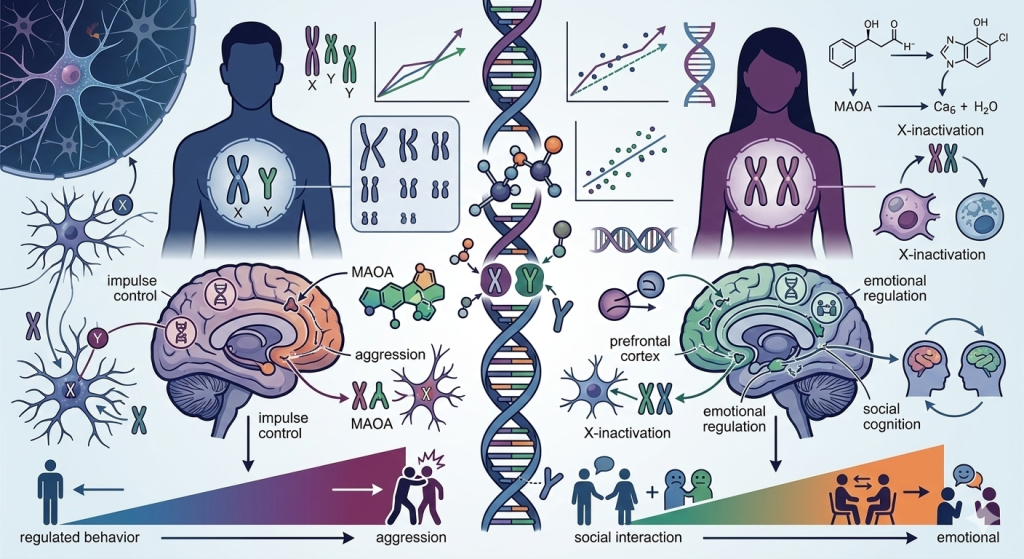
Encuentra más información en nuestro repositorio digital La violencia es una preocupación mundial acuciante, que causa más de 475.000 muertes cada año y afecta desproporcionadamente a las mujeres y los niños. Mientras que los factores ambientales, genéticos y epigenéticos contribuyen al comportamiento violento, este artículo se centra en el aspecto genético, particularmente las funciones de los cromosomas X e Y. El gen monoamino oxidasa A () influye en el catabolismo de los neurotransmisores y se localiza en el cromosoma X. Los polimorfismos, como las variantes de repetición en tándem asociadas con baja actividad transcripcional, se han vinculado a la agresión, particularmente en hombres, ya que la inactivación del cromosoma X complica los estudios en mujeres. Otras variantes, incluidos los polimorfismos de un solo nucleótido, también se han asociado con el comportamiento violento. Además, los individuos con síndrome de X frágil a menudo exhiben patrones de agresión aumentados. El gen de la región Y del cromosoma Y que determina el sexo () juega un papel fundamental en el desarrollo sexual y el comportamiento masculino. Además de dirigir la formación testicular, se expresa en otros tejidos, influyendo en la violencia al modular la liberación de catecolaminas e inhibir la monoamiooxidasa A. Las hipótesis evolutivas sugieren que pueden haberse adaptado para promover la agresión masculina para sobrevivir. A pesar de las pruebas que vinculan los cromosomas X e Y con la violencia, los resultados contradictorios subrayan la necesidad de más investigación para comprender plenamente su papel en el comportamiento agresivo. Este artículo se centra en el componente genético, analizando específicamente la evidencia bibliográfica que asocia la genética de los cromosomas Y y X con el comportamiento violento. Accede al artículo completo aquí
Obtención del esqueleto de una zarigüeya andina (Didelphis pernigra) mediante un protocolo osteotécnico modificado del laboratorio de anatomía animal de la Universidad Central del Ecuador
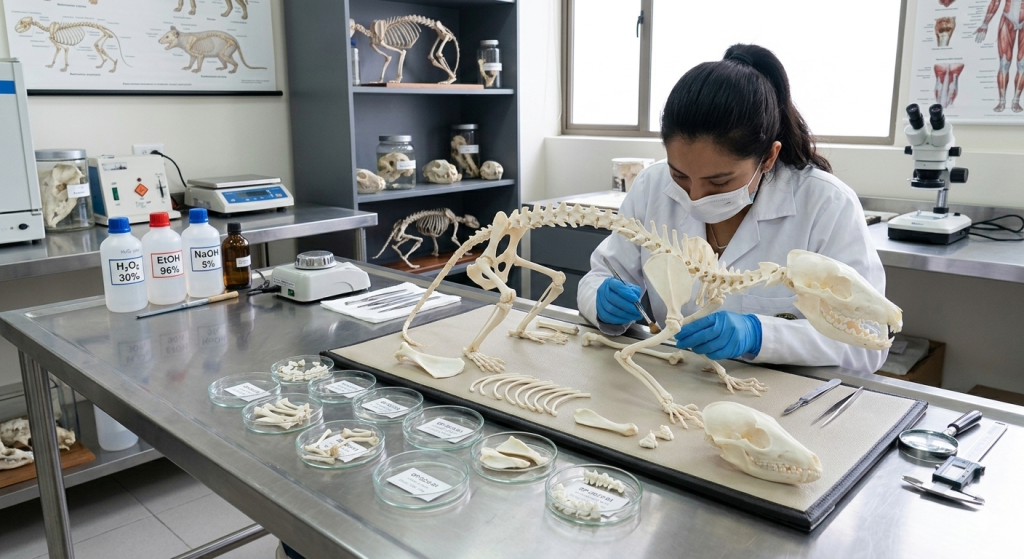
Encuentra más información en nuestro repositorio digital Los métodos osteotécnicos permiten la preparación y conservación de muestras óseas libres de residuos orgánicos. Estos métodos consisten en una combinación de procesos naturales, químicos y/o físicos que permiten la creación de esqueletos realistas con fines educativos y de exhibición. El Laboratorio de Anatomía Animal de la Facultad de Medicina Veterinaria de la Universidad Central del Ecuador recibió una donación de zarigüeya andina (Didelphis pernigra), un marsupial omnívoro ampliamente distribuido en la región andina y a menudo atacado debido a una falta de comprensión de su papel ecológico. Este estudio presenta modificaciones hechas al protocolo osteotécnico estándar para preservar la morfología o sea lo más cerca posible de su estado natural. Después de dividir el espécimen en cuatro partes – cráneo, extremidades, complejo costal-esternal y columna vertebral – la primera modificación se realizó cocinando las partes en una solución de cloruro de sodio al 10 % durante cuatro horas en lugar de utilizar óxido de calcio. Los huesos se extirparon cada 15 minutos para extirpar manualmente el tejido blando residual. Para el blanqueamiento, la concentración de peróxido de hidrógeno se incrementó del 10 % al 30 %. Los huesos fueron luego enjuagados con agua y secados al sol durante cuatro días. Como se preservó el tejido conectivo entre las articulaciones de la columna vertebral, las manos y los pies, el montaje del esqueleto sólo requirió la unión de las cuatro secciones principales con alambre y silicona, evitando la necesidad de un adhesivo de cianoacrilato combinado con bicarbonato sódico. Estas tres modificaciones dieron como resultado un esqueleto de 220 huesos con una coloración natural y tejido conectivo mantenido entre pequeñas articulaciones. El espécimen fue suspendido de un marco de madera para facilitar la movilidad y exhibición durante las actividades educativas veterinarias y ambientales. Accede al artículo completo aquí
Complicación tardía debida a rinoplastia con hilos de tensión no absorbibles: Un informe de caso
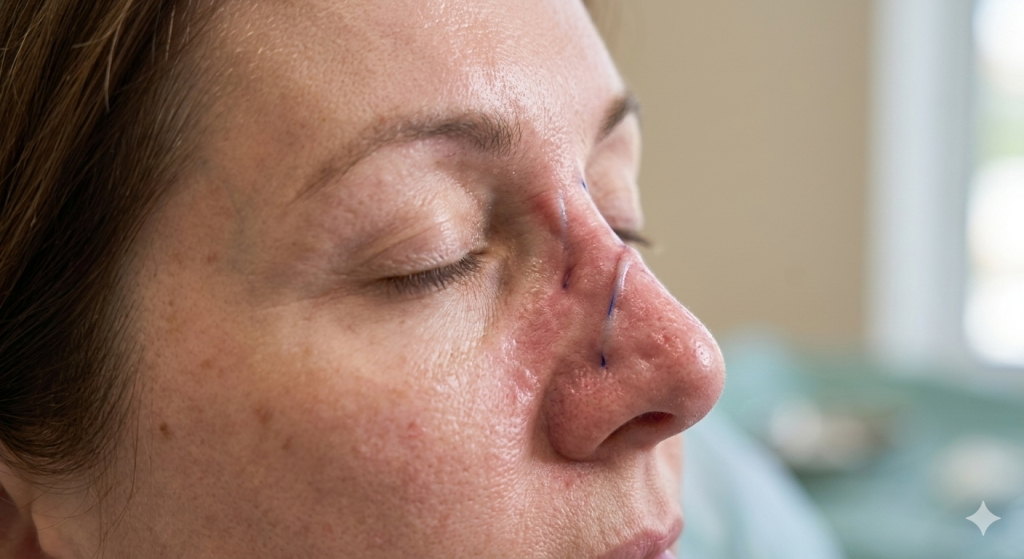
Encuentra más información en nuestro repositorio digital Introducción: El rinomodelismo es un procedimiento estético mínimamente invasivo que ofrece una rápida recuperación y menores costos en comparación con la rinoplastia quirúrgica. Sin embargo, el uso de hilos tensores no absorbibles puede provocar complicaciones tardías que requieren intervención quirúrgica. Presentación del caso: Una paciente de 27 años se sometió a modelado con hilo tensor no absorbible hace diez años. Presentaba asimetría nasal, dificultad respiratoria y sensación de cuerpo extraño en la cavidad nasal izquierda. El examen clínico reveló laterorhinia del lado izquierdo, cavidades nasales asimétricas y un hilo de tensión saliente. Se realizó una rinoseptoplastia abierta, revelando extrusión de hilo, formación de granuloma y rotura parcial del cartílago alar derecho. Se extrajo el hilo y se realizó la corrección estructural con septoplastia y injerto de cartílago. Discusión: A diferencia de los hilos absorbibles, que se degradan en cuestión de meses, los hilos no absorbibles pueden causar complicaciones tardías que requieren su extracción quirúrgica.Discussion: Unlike absorbable threads, which degrade within months, non-absorbable threads can cause late complications requiring surgical removal. Conclusión: Este caso pone de relieve una complicación tardía del rinomodelismo, descrita anteriormente pero subestimada, que requiere intervención quirúrgica diez años después. La rinoseptoplastia abierta restauró con éxito la función nasal y la estética, haciendo hincapié en la importancia del seguimiento a largo plazo y la experiencia profesional. Accede al artículo completo aquí
Sobre el análisis de propagación de ondas de flexión en vigas poroelásticas de orden superior
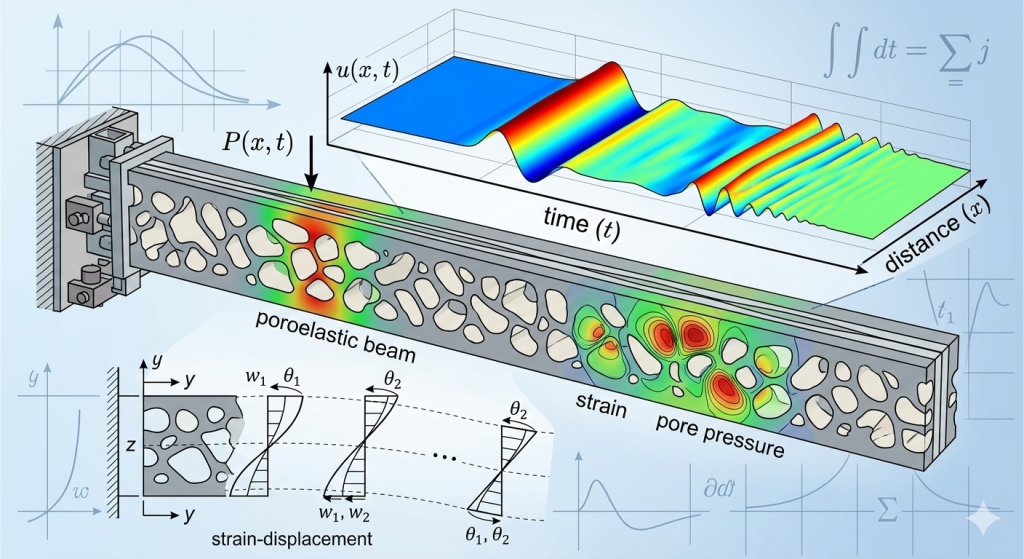
Encuentra más información en nuestro repositorio digital El presente trabajo utiliza la teoría de deformación por cizallamiento de orden superior para investigar el comportamiento de propagación de un haz de biocompuesto poroelástico (FGPB) colocado en un medio elástico. Se utilizaron titanio-hidroxiapatita y una aleación de oro-hidroxiapatita como ingredientes para dos biocompuestos. Se supone que la estructura está soportada por un medio elástico. Se utiliza un esquema mejorado de homogéneneización de ley de potencia que calcula la porosidad para calcular las características materiales efectivas del haz FGPB. El resultado mostró que el número de ondas, los coeficientes de porosidad y los parámetros de Winkler-Pasternak tienen un papel cada vez mayor en la frecuencia de las ondas y la velocidad de fase de ambos biocompuestos. El índice de potencia también presentó diferentes comportamientos en dos biocompuestos. Enfatizando el análisis teórico, el estudio actual muestra cómo el cambio en los patrones de distribución del medio elástico y la cantidad de porosidad puede afectar el rendimiento y la eficiencia de los biocompuestos. Estos hallazgos pueden ser eficaces en el diseño y optimización de materiales biocompuestos con propiedades mecánicas deseables y diversas aplicaciones en la bioingeniería y los materiales compuestos. Accede al artículo completo aquí
Vigor micelial, crecimiento, características fisicoquímicas y sensoriales de Lentinula edodes producidos a partir de residuos agroindustriales y sus digestatos anaeróbicos
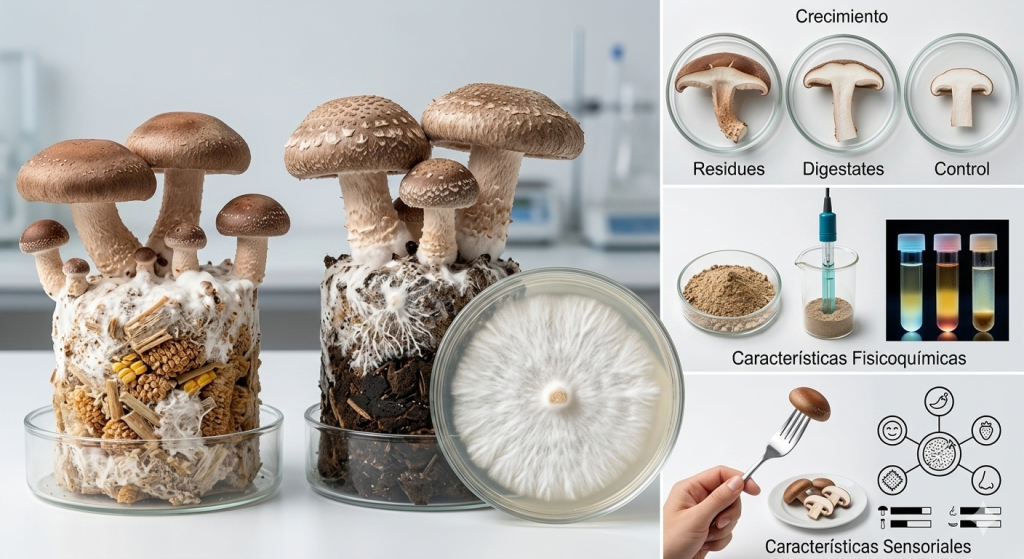
Encuentra más información en nuestro repositorio digital En algunos países de América Latina, los desechos agroindustriales (AIW) se reservan en cantidades significativas, ya que son tratados como basura común sin un plan de manejo específico. Una alternativa viable sería utilizar AIW como sustratos para otros procesos de valorización. En esta investigación, se propuso cultivar Lentinula edodes, en sustratos preparados a partir de mezclas de AIW como cáscara de cacao, cáscara de coco, bagazo de caña de azúcar y cáscara de arroz. Además, el digestato derivado de la digestión anaeróbica de una mezcla de estos AIW también se evaluó para cultivar este hongo. Se evaluó el vigor micelial de Lentinula edodes durante el cultivo in vitro, la producción de semillas y el cultivo a nivel del sustrato preparado a partir de AIW. Se realizó un análisis físico, de crecimiento y fisicoquímico del hongo cultivado y un análisis sensorial de los basidiomas. El mayor vigor micelial se obtuvo en medio de cultivo PDA, a pH 7,0, extracto AIW, incubación a 20 °C e inóculo de esporas en consistencia líquida. El digestato anaeróbico produjo basidiomas con mayor pH, proteínas, minerales y contenido de humedad (6,7 0,1; 20,7 0,1 %; 4,5 0,3 %; 86,9 0,6 %, respectivamente), en comparación con el ensayo sin digestato anaerobio. Los champiñones producidos mostraron una diferencia moderada en el sabor en comparación con los champiñones comerciales. Se concluye que Lentinula edodes se desarrolló muy bien en la mezcla de los mencionados AIW con un alto valor nutricional y sensorial. Accede al artículo completo aquí
Caracterización de una variante en el gen KCNH2 en un paciente ecuatoriano con síndrome de QT largo: A case report
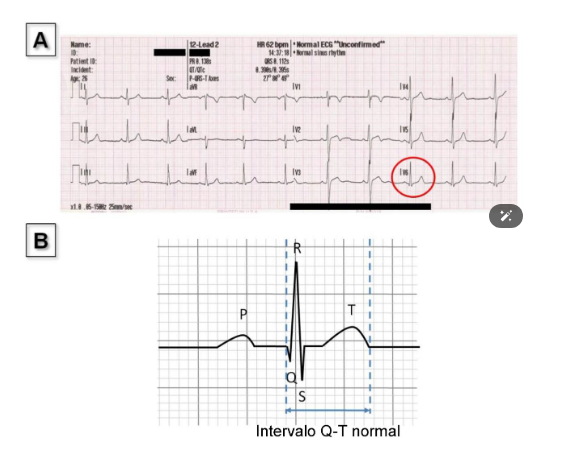
Encuentra más información en nuestro repositorio digital El trastorno del espectro autista (TEA) es una afección neuroevolutiva frecuentemente asociada con síntomas gastrointestinales, disbiosis intestinal y disfunciones metabólicas como la resistencia a la insulina (RI). Pruebas recientes sugieren que la microbiota intestinal puede influir en los procesos metabólicos y neurológicos a través del eje intestino-cerebro-metabólico. Esta revisión explora los mecanismos moleculares que vinculan la disbiosis, el IR y el ASD, centrándose en vías como la activación de TLR/NF-κ B, la disrupción de PI3K/Akt/mTOR y la acción de metabolitos microbianos como los ácidos grasos de cadena corta (SCFA), los lipopolisacáridos (LPS) y el ácido γ-aminobutírico (GABA). Discutimos cómo la disbiosis puede contribuir al aumento de la permeabilidad intestinal, la inflamación sistémica y la activación neuroinmune, afectando en última instancia el desarrollo del cerebro y el comportamiento. Las alteraciones microbianas comunes en los TEA e IR, incluyendo un aumento de Clostridium, Desulfovibrio y Alistipes, y una reducción de Bifidobacterium y géneros productores de butirato, sugieren una patofisiología compartida. También destacamos posibles estrategias terapéuticas, como la modulación de la microbiota, el tratamiento del factor de crecimiento similar a la insulina 1 (IGF-1) y las intervenciones dietéticas. La comprensión de estos mecanismos interconectados puede apoyar el desarrollo de enfoques dirigidos a la microbiota para los individuos con comorbilidades metabólicas del TEA. Accede al artículo completo aquí