

Infecciones asociadas a la atención de salud y mortalidad en pacientes pediátricos críticamente enfermos
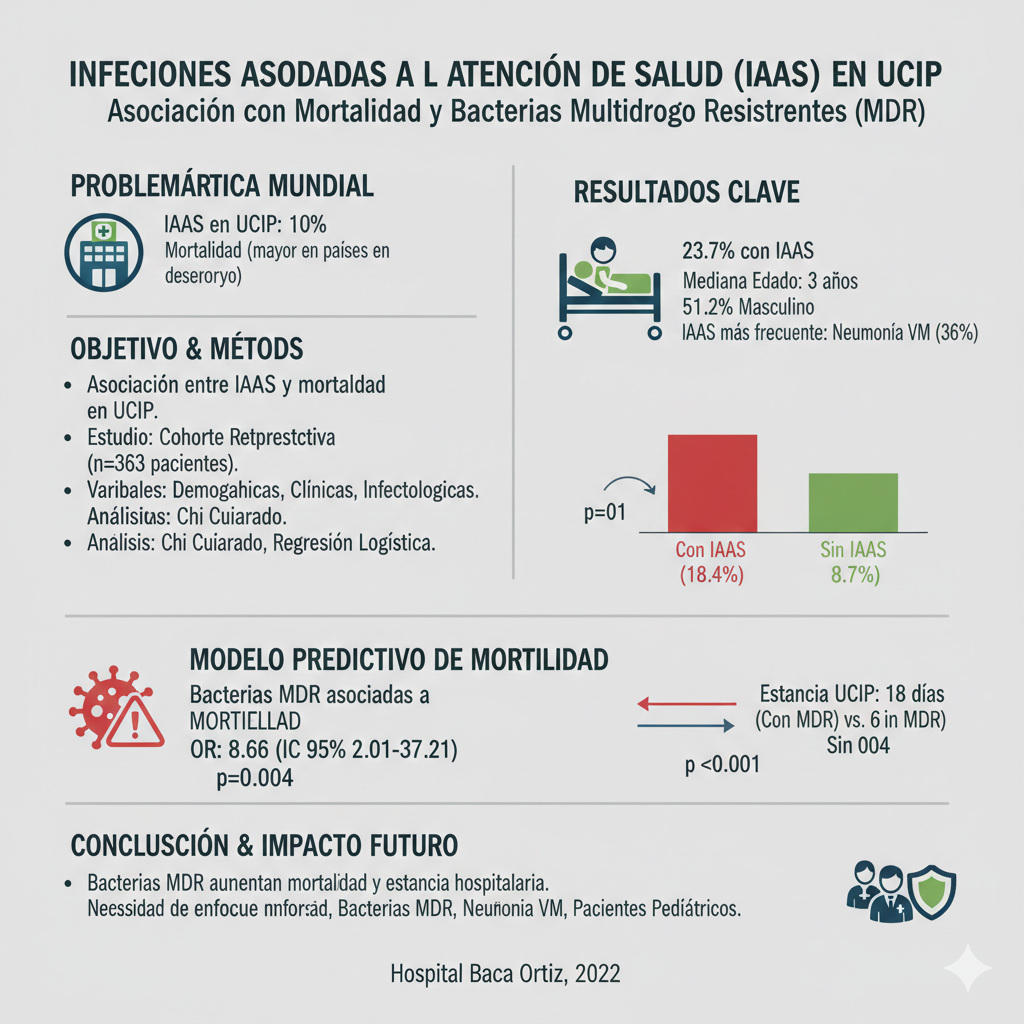
Encuentra más información en nuestro repositorio digital Las infecciones asociadas a la atención de salud (IAAS) en cuidados intensivos pediátricos (UCIP) resultan en una problemática mundial. La mortalidad derivada de IAAS es de 10% pudiendo ser más alta en países en vías de desarrollo. Objetivo: Determinar la asociación entre IAAS y mortalidad en pacientes pediátricos ingresados en Terapia Intensiva de un hospital de tercer nivel. Pacientes y Método: Estudio observacional de cohorte retrospectiva. Se analizaron variables demográficas, clínicas (diagnóstico, área de procedencia, días de estancia, mortalidad) e infectológicas (tipo de microorganismo, tipo de IAAS, multidrogo resistencia). Mediante prueba Chi cuadrado se evaluó la relación entre mortalidad y desarrollo de IAAS. A través de un modelo de regresión logística se evaluaron otras variables explicativas de la mortalidad. Resultados: Se estudiaron 363 pacientes, de los cuales el 23,7% fue diagnosticado con IAAS. La mediana de edad fue 3 años (RIC: 1-9). El 51,2% correspondieron al sexo masculino. La IAAS más frecuente fue la neumonía asociada a ventilación mecánica (36%). La mortalidad global fue del 10,7 % con diferencia significativa entre los grupos con y sin IAAS (18,4%, vs. 8,7% p:0,01). El modelo predictivo de mortalidad concluyó asociación entre mortalidad y bacterias multidrogo resistentes (MDR) (OR:8,66 IC 95% 2,01-37,21 p= 0,004). Este grupo presentó más días de hospitalización en UCIP (18 vs. 6 días), p = <0,001. Conclusiones: Para los pacientes ingresados en UCIP del Hospital Baca Ortiz durante el año 2022, la presencia de bacterias MDR se asoció con incrementos de mortalidad y estancia hospitalaria. Accede al artículo completo aquí
Tecnologías de conversión de biomasa basadas en un marco metal-orgánico para la biorrefinería de microalgas en la industria alimentaria
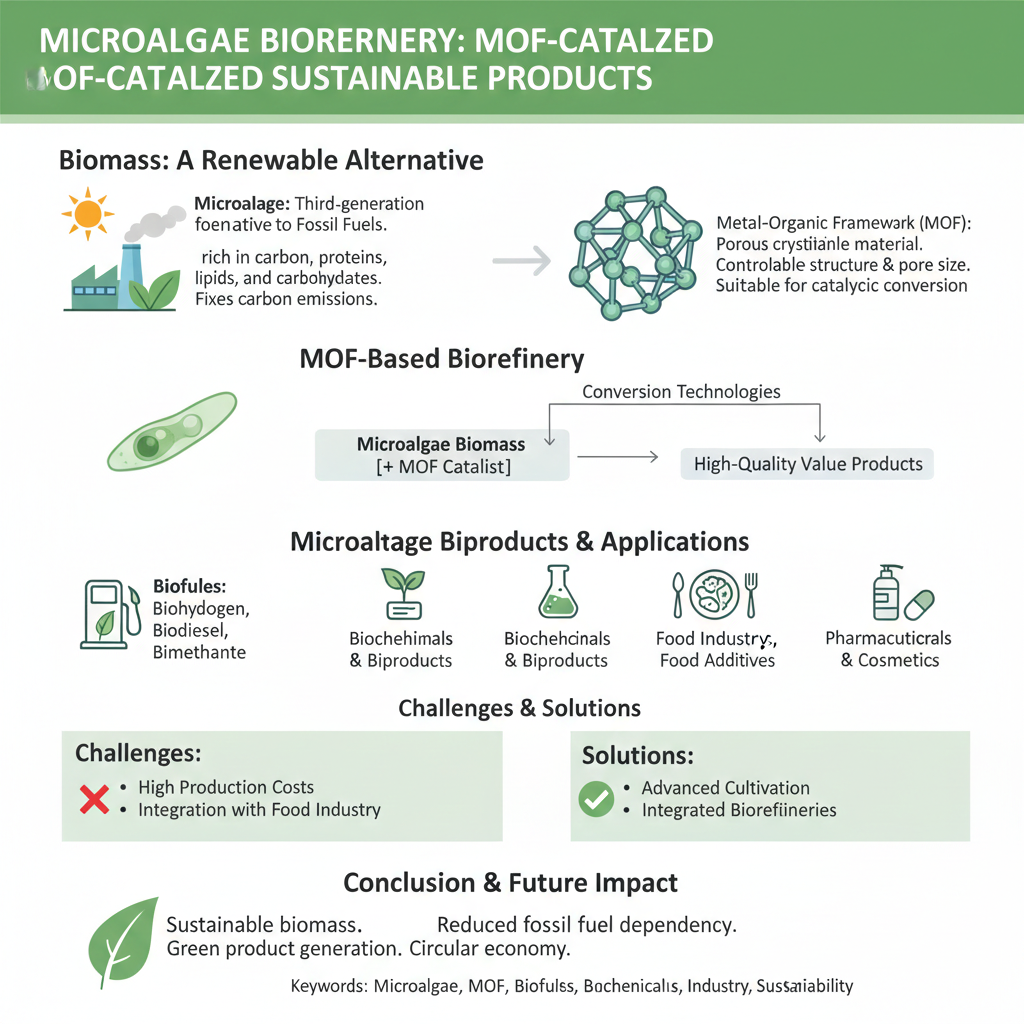
Encuentra más información en nuestro repositorio digital La biomasa es una valiosa energía renovable adaptada como alternativa a los combustibles fósiles tradicionales. Aparte de los combustibles, la biomasa se sintetiza en productos muy valiosos que se utilizan en diversas formas, incluidos biocombustibles, bioquímicos, bioproductos, material de embalaje y se utilizan en las industrias farmacéutica, cosmética y nutracéutica. En particular, las microalgas, una materia prima de tercera generación conocida por su rico contenido en carbono, poseen proteínas lipídicas y carbohidratos que producen una variedad de productos verdes como el bioetanol, el biohidrógeno, el biodiésel y el biometano, y también fijan la emisión de carbono a cierta cantidad en la atmósfera. Sin embargo, la conversión de microalgas en presencia de un catalizador como un marco metal-orgánico (MOF) produce productos valiosos de alta calidad. Un MOF es un material cristalino poroso donde se puede controlar la estructura y el tamaño de los poros, lo que lo hace adecuado para reacciones catalíticas y rutas de conversión adecuadas. Esta revisión explica brevemente la situación prevaleciente de las microalgas como biomasa sostenible y presenta sus componentes para la biorrefinería de microalgas en productos valiosos y su aplicación en la industria alimentaria. Se elaboran las propiedades, características y diversas tecnologías de conversión basadas en MOF para la conversión de biomasa con su aplicación. Además, se aclara el uso de productos de valor producidos a partir de la biorrefinería de microalgas en la industria alimentaria y su importancia. Además, también se presentan los desafíos de integrar los procesos de biorrefinería con las operaciones de la industria alimentaria y sus soluciones. Accede al artículo completo aquí
Prevalencia y factores de mortalidad en la hospitalización inicial por gastroschisis; Prevalencia y factores de mortalidad en la hospitalización inicial por gastrosquisis
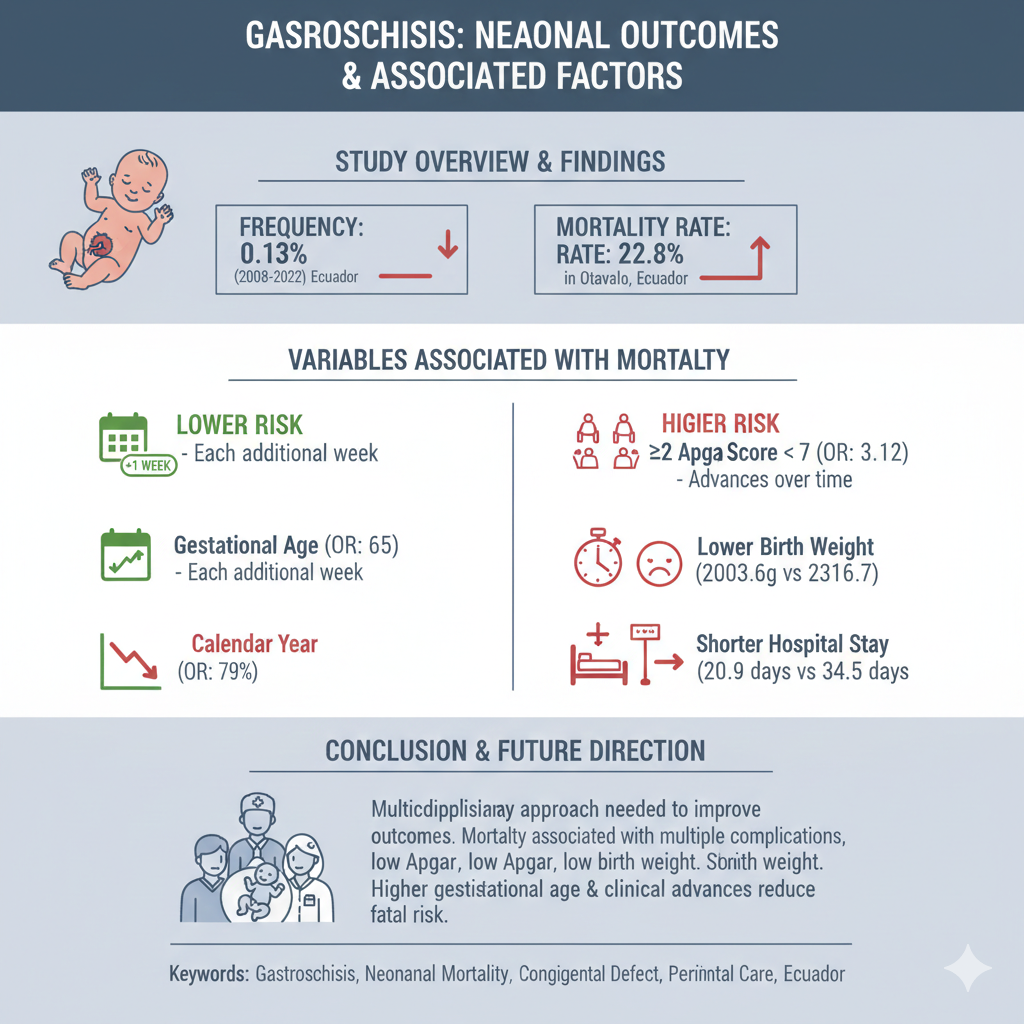
Encuentra más información en nuestro repositorio digital La gastroschisis es un defecto congénito caracterizado por la protrusión de las vísceras abdominales a través de una abertura paraumbilical. Objetivo: Determinar la frecuencia de gastroschisis y describir las variables asociadas con la mortalidad neonatal. Pacientes y método: Estudio transversal basado en datos del Sistema de Información Perinatal del Hospital Gineco Obstétrico Isidro Ayora (2008-2022). Se analizaron las variables sociodemográficas, obstétricas y neonatales mediante pruebas bayesianas para la determinación de variables de contingencia, regresión logística y analógica de prueba t bayesiana. Resultados: Se incluyó un total de 175 neonatos (58,9% mujeres). La frecuencia de gastroschisis fue del 0,13% (IC 95%: 0,11-0,15), con una tasa de mortalidad del 22,8%. Hubo una asociación negativa con la edad gestacional (OR: 0,65; IC 95%: 0,49-0,85) y el año natural (OR: 0,79; IC 95%: 0,68-0,91), lo que indica una menor mortalidad por cada semana adicional de gestación y a lo largo del tiempo. La presencia de 2 complicaciones (OR: 3,46; IC 95%: 1,30-7,12) y el puntaje de Apgar < 7 a los cinco minutos (OR: 3,12; IC 95%: 1,01-60,91) se asociaron positivamente con mortalidad. Los neonatos fallecidos tenían menor peso al nacer (2.003,6g frente a 2.316,7g; BF10=35,2) y una estancia hospitalaria más corta (20,9 días frente a 34,5 días; BF10=204). Conclusiones: La gastroschisis mostró una alta frecuencia, con mortalidad asociada a múltiples complicaciones, bajas puntuaciones de Apgar y bajo peso al nacer, mientras que una edad gestacional más alta y avances en el manejo clínico a lo largo de los años se asociaron con un menor riesgo fatal. Se hace hincapié en la necesidad de un enfoque multidisciplinario para mejorar los resultados neonatales en esta población. Accede al artículo completo aquí
Biorremediación de aguas residuales de restaurantes mediante la utilización de Galdieria sulphuraria extremófila: un enfoque que contribuye a la bioeconomía circular y la sostenibilidad ambiental
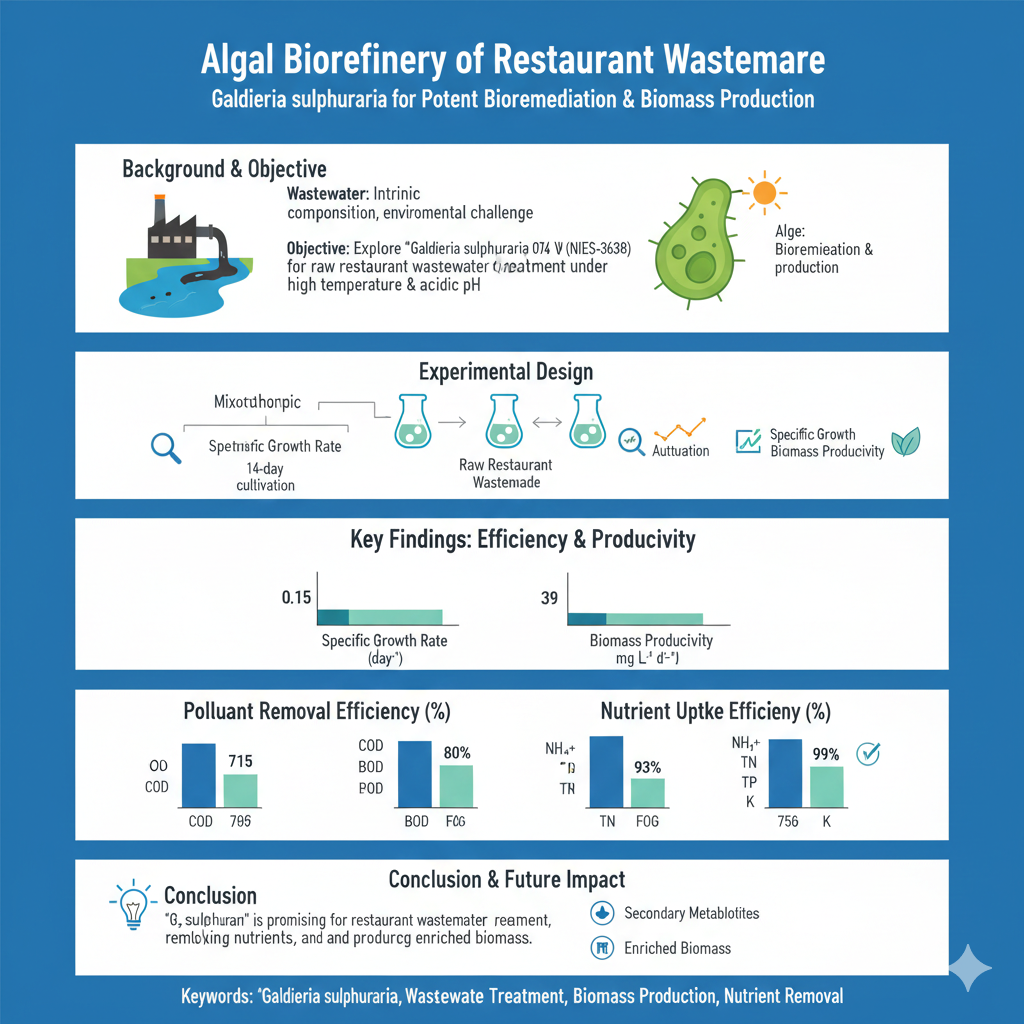
Encuentra más información en nuestro repositorio digital Recientemente, algunas ciencias aplicadas se han centrado en la biorrefinería de aguas residuales debido a su composición intrínseca. Se exploró el tratamiento de aguas residuales a base de algas por su potente capacidad de biorremediación y producción de biomasa, que puede utilizarse en diversas aplicaciones. Al considerar el papel del cultivo de microalgas en los sistemas integrados de producción, especialmente cuando se utilizan aguas residuales y efluentes gaseosos, la búsqueda de nuevas cepas potenciales es crucial. Esta investigación exploró el potencial de la microalga Galdieria sulphuraria (G. sulphuraria) 074 W (NIES-3638) para bioremediar aguas residuales crudas de restaurantes debido a sus características distintivas, incluyendo alta temperatura y ajustes de pH ácido. Las condiciones de cultivo se sometieron a tres modos de cultivo (mixotrófico, heterotrófico y autotrófico) durante 14 días. Durante el cultivo de G. sulphuraria se examinaron diversas evaluaciones, entre ellas la densidad óptica, la tasa de crecimiento específico y la productividad de la biomasa. Además, se examinó la eficiencia de biorremediación de G. sulphuraria para la eliminación de contaminantes, incluyendo demanda química de oxígeno (DQO), demanda bioquímica de oxígeno (DBO), grasas, aceite, grasa (FOG) y absorción de nutrientes como nitrógeno amoniacal (NH4+-N), nitrógeno total (TN), fósforo total (TP) y potasio (K). G. sulfuraria cultivada con aguas residuales de restaurantes obtuvo 0,15 día 1 para la tasa de crecimiento específico y 39 mg L-1 d-1 productividad de biomasa. Las eficiencias máximas de eliminación para DQO, DBO, FOG, NH4+-N, TN, TP y K fueron del 71%, 80%, 66%, 96%, 93%, 99% y 75%, respectivamente. En general, este estudio reveló que el uso de G. sulphuraria es un enfoque prometedor para tratar las aguas residuales de los restaurantes mediante la eliminación de contaminantes, la ingesta de nutrientes y la producción de biomasa enriquecida que puede utilizarse para generar metabolitos secundarios. Accede al artículo completo aquí
Impacto de las interacciones articulares en túneles segmentados de hormigón: modelado numérico avanzado para la resistencia sísmica
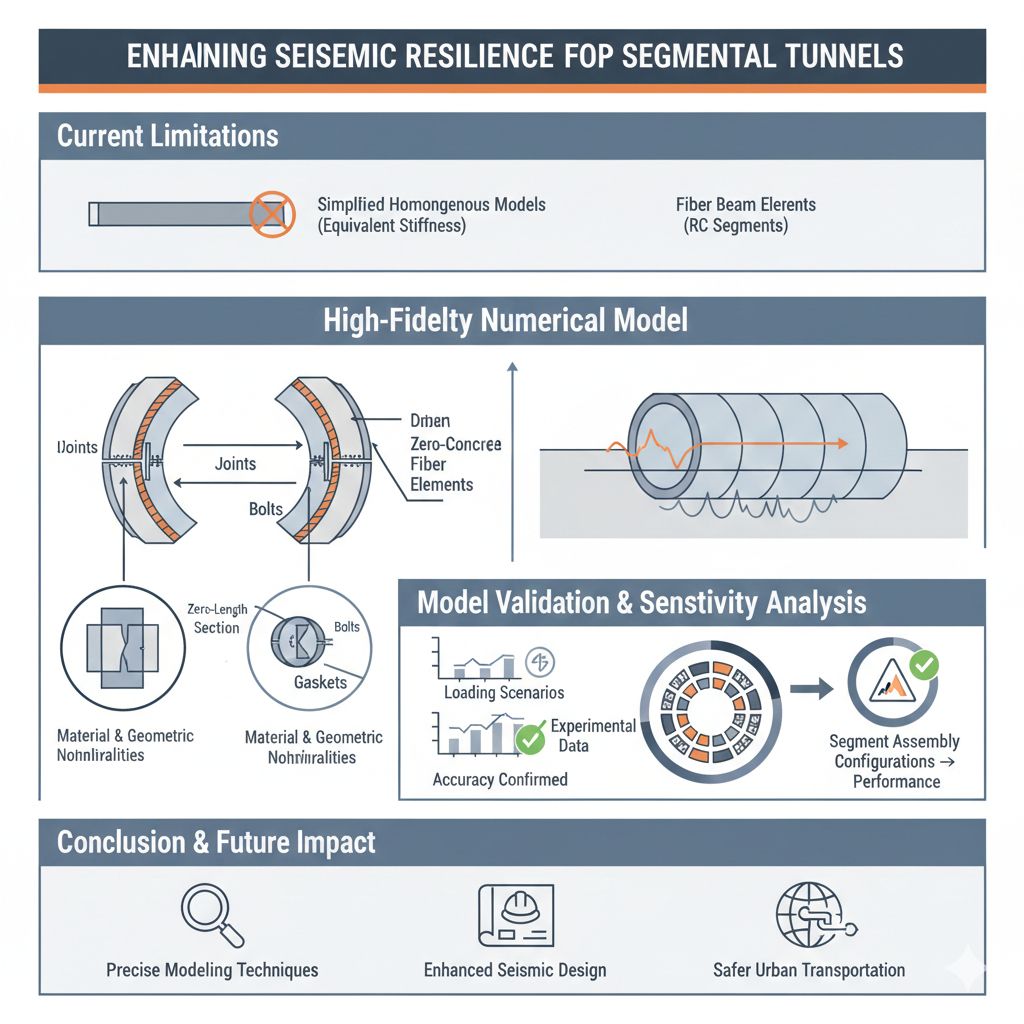
Encuentra más información en nuestro repositorio digital Garantizar la resistencia sísmica de los túneles segmentados es esencial para salvaguardar los sistemas de transporte urbano, especialmente en las zonas propensas a terremotos donde la integridad estructural es crítica. Los métodos convencionales de análisis sísmico se basan típicamente en modelos simplificados, utilizando elementos homogéneneos del haz o de la cáscara con propiedades equivalentes de la rigidez para el comportamiento aproximado del túnel bajo carga sísmica Para superar estas limitaciones, este estudio presenta un modelo numérico avanzado de alta fidelidad diseñado para túneles segmentados, que incorpora no linealidades materiales y geométricas mientras mantiene la eficiencia computacional. El modelo propuesto utiliza elementos de viga de fibra para representar con precisión los segmentos de hormigón armado. Por el contrario, los elementos de sección de longitud cero simulan las intrincadas interacciones entre juntas de túnel, pernos, juntas y superficies de hormigón. La precisión del modelo se valida rigurosamente mediante datos experimentales de tres escenarios de carga distintos, lo que confirma su capacidad para predecir con fiabilidad la respuesta sísmica de los túneles segmentados. Más allá de la validación experimental, se realiza un análisis de sensibilidad exhaustivo para examinar la influencia de las diferentes configuraciones de ensamblaje de segmentos en el comportamiento sísmico de los túneles. Los resultados indican que la disposición y las propiedades mecánicas de los segmentos afectan significativamente el rendimiento estructural general, destacando la necesidad de técnicas de modelado precisas. El modelo propuesto es una herramienta valiosa para mejorar el diseño sísmico de las redes de transporte subterráneo al ofrecer una representación más detallada y precisa del comportamiento de los túneles segmentados. Accede al artículo completo aquí
Síntesis y potencial terapéutico de nanopartículas de óxido de cobre a partir de hongos endófitos: actividades y mecanismos anticáncer
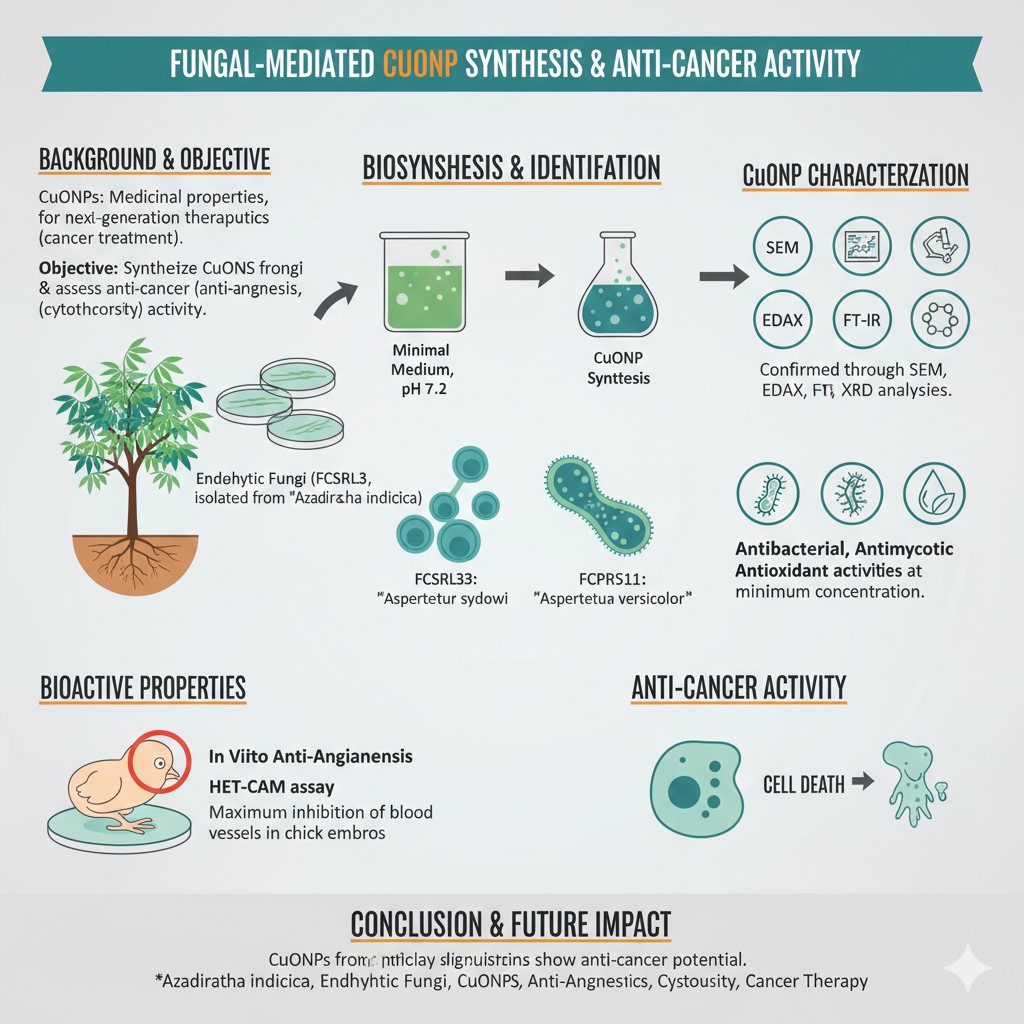
Encuentra más información en nuestro repositorio digital Las nanopartículas de óxido de cobre (CuONPs) contienen propiedades medicinales y son un componente esencial de la próxima generación debido a sus propiedades únicas. CuONPs tienen un papel vital en la terapéutica, especialmente para el tratamiento del cáncer. El objetivo principal de este estudio fue sintetizar los CuONPs y evaluar la actividad anticancerígena, incluyendo los análisis in vitro de anti-angiogénesis y citotoxicidad. CuONPs se sintetizan utilizando la suspensión enzimática de cepas fúngicas endophytic FCSRL3 y FCPRS11 aisladas de Azadirachta indica cultivadas en un medio mínimo a pH óptimo 7.2. Se evaluaron alrededor de 14 diferentes hongos endofíticos confinados del árbol neem, y las propiedades antagónicas y antioxidantes. Los eficientes FCSRL3 y FCPRS11 fueron identificados como Aspergillus sydowi y Aspergillus versicolor a nivel molecular. Los CuONPs sintetizados de dos hongos se confirmaron mediante determinación de caracterización utilizando análisis SEM, EDAX, FT-IR y XRD. Los CuONPs revelaron la máxima actividad antibacteriana, antimicótica y antioxidante en concentraciones mínimas, ejerciendo las mayores propiedades bioactivas. La actividad antiangiogénica de los CuONPs de dos cepas fúngicas diferentes mostró una inhibición máxima de los vasos sanguíneos en embriones de pollo, y la evaluación se realizó utilizando HET-CAM. Los resultados de esta investigación demuestran el notable papel que desempeñan los CuONPs en los remedios contra el cáncer.https://doi.org/10.1016/j.bioorg.2025.108679 Accede al artículo completo aquí