

Encuentra más información en nuestro repositorio digital
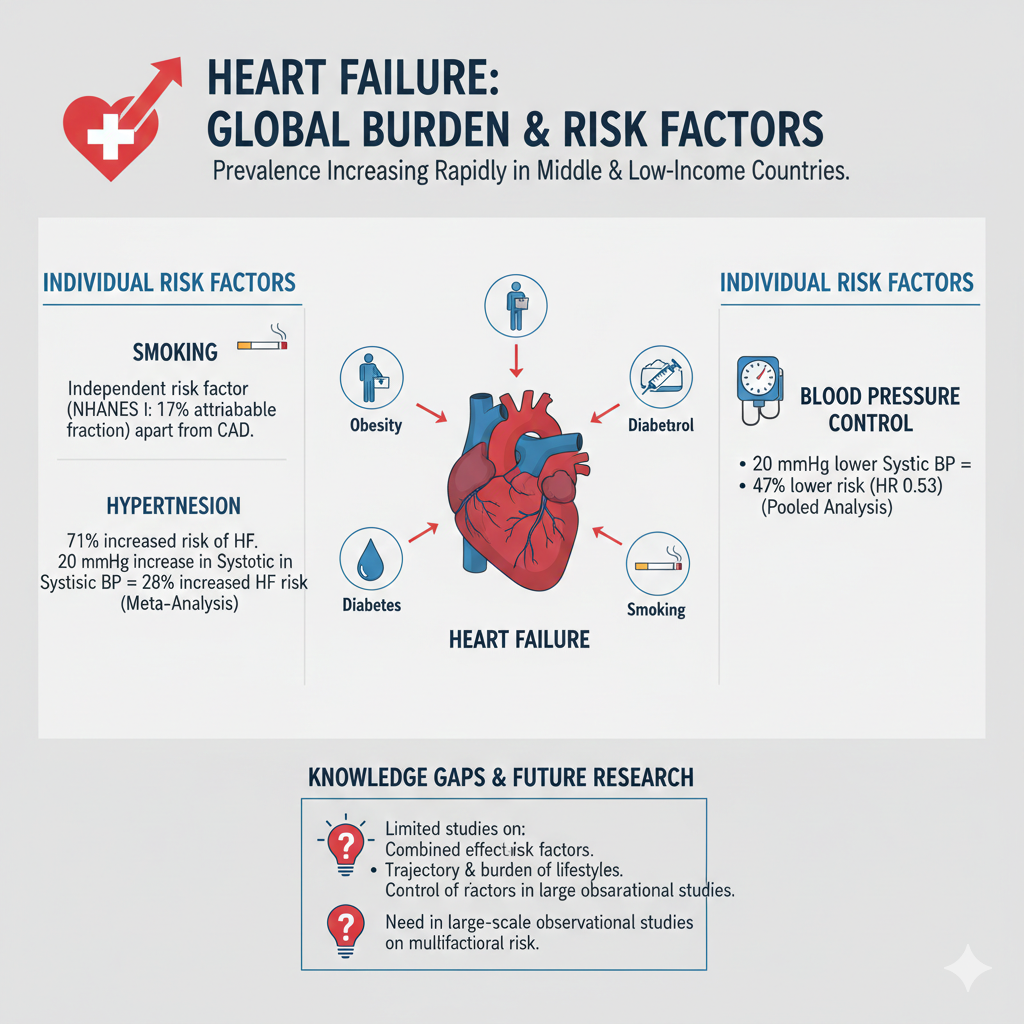
La prevalencia de la insuficiencia cardíaca (IC) está aumentando rápidamente, especialmente en los países de ingresos medios y bajos, lo que contribuye a los considerables costos del tratamiento y debilita sus sistemas de salud.1 Individualmente, los factores de riesgo cardiovascular están asociados con un mayor riesgo de desarrollar IC.
Por ejemplo, el estudio NHANES I informó que el tabaquismo es un factor de riesgo independiente para la IC incidente, aparte de la enfermedad coronaria (fracción atribuible a la población = 17%). 2 Un metanálisis reciente mostró que la hipertensión está asociada con un aumento del 71% en el riesgo de IC y que un aumento de 20 mmHg en la presión arterial sistólica está asociado con un aumento del 28% en el riesgo de IC.3 Similarmente, un análisis combinado de 61 estudios prospectivos sobre la presión arterial y la mortalidad por IC informó una razón de riesgo (HR) de 0,53 [intervalo de confianza (IC) del 95%: 0,48-0,59], para una presión sanguínea sistólica inferior a 20 mmHg4 Sin embargo, pocos estudios han examinado la combinación y el efecto de la trayectoria, la carga de los estilos de vida y el control de los factores de riesgo en grandes estudios observacionales.