

Encuentra más información en nuestro repositorio digital
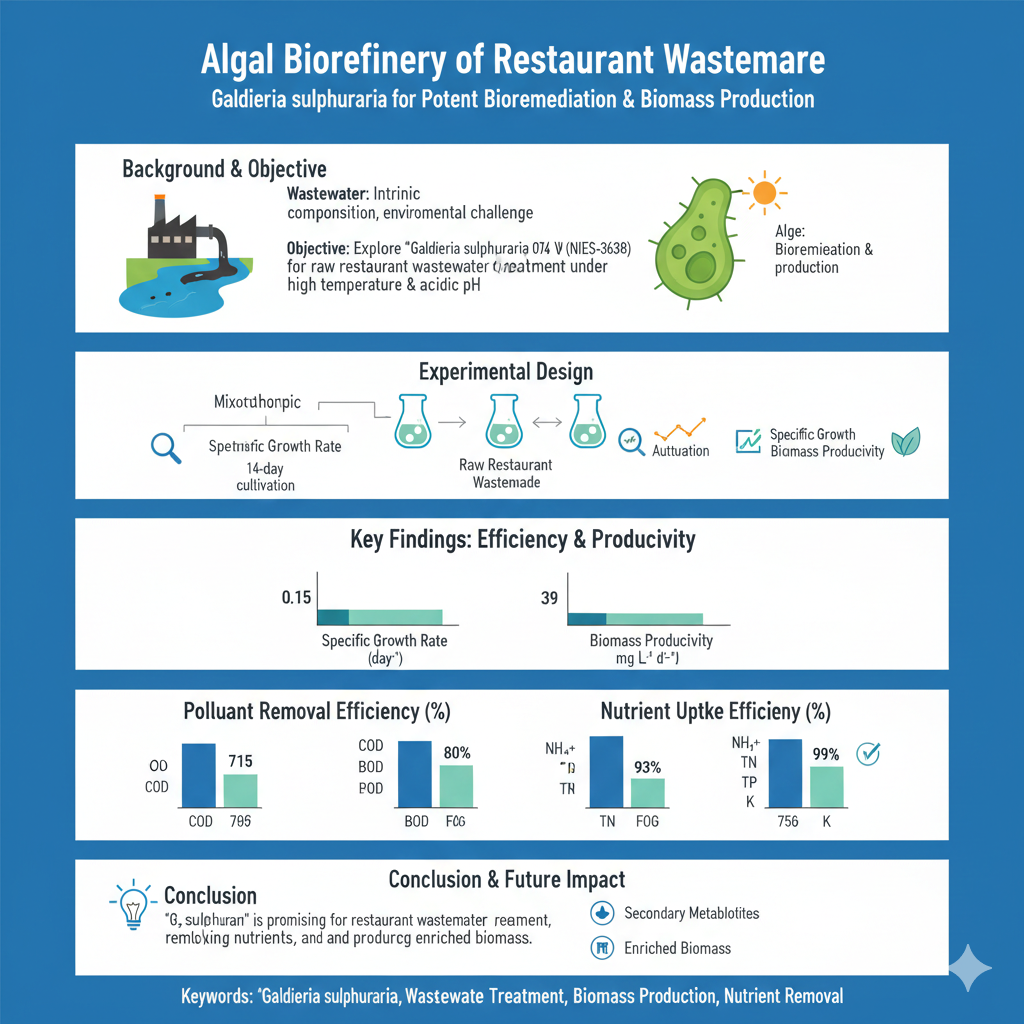
Recientemente, algunas ciencias aplicadas se han centrado en la biorrefinería de aguas residuales debido a su composición intrínseca. Se exploró el tratamiento de aguas residuales a base de algas por su potente capacidad de biorremediación y producción de biomasa, que puede utilizarse en diversas aplicaciones. Al considerar el papel del cultivo de microalgas en los sistemas integrados de producción, especialmente cuando se utilizan aguas residuales y efluentes gaseosos, la búsqueda de nuevas cepas potenciales es crucial. Esta investigación exploró el potencial de la microalga Galdieria sulphuraria (G. sulphuraria) 074 W (NIES-3638) para bioremediar aguas residuales crudas de restaurantes debido a sus características distintivas, incluyendo alta temperatura y ajustes de pH ácido.
Las condiciones de cultivo se sometieron a tres modos de cultivo (mixotrófico, heterotrófico y autotrófico) durante 14 días. Durante el cultivo de G. sulphuraria se examinaron diversas evaluaciones, entre ellas la densidad óptica, la tasa de crecimiento específico y la productividad de la biomasa.
Además, se examinó la eficiencia de biorremediación de G. sulphuraria para la eliminación de contaminantes, incluyendo demanda química de oxígeno (DQO), demanda bioquímica de oxígeno (DBO), grasas, aceite, grasa (FOG) y absorción de nutrientes como nitrógeno amoniacal (NH4+-N), nitrógeno total (TN), fósforo total (TP) y potasio (K). G. sulfuraria cultivada con aguas residuales de restaurantes obtuvo 0,15 día 1 para la tasa de crecimiento específico y 39 mg L-1 d-1 productividad de biomasa.
Las eficiencias máximas de eliminación para DQO, DBO, FOG, NH4+-N, TN, TP y K fueron del 71%, 80%, 66%, 96%, 93%, 99% y 75%, respectivamente. En general, este estudio reveló que el uso de G. sulphuraria es un enfoque prometedor para tratar las aguas residuales de los restaurantes mediante la eliminación de contaminantes, la ingesta de nutrientes y la producción de biomasa enriquecida que puede utilizarse para generar metabolitos secundarios.