

Encuentra más información en nuestro repositorio digital
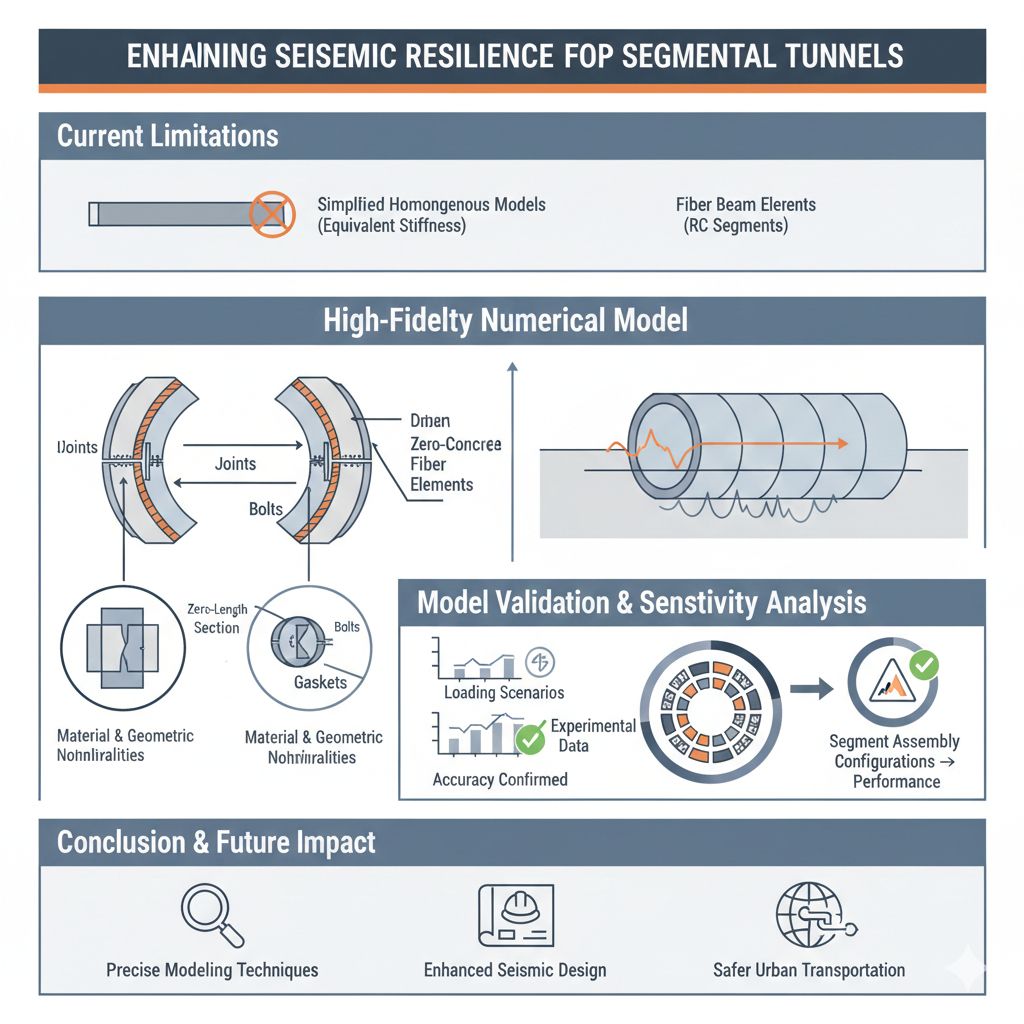
Garantizar la resistencia sísmica de los túneles segmentados es esencial para salvaguardar los sistemas de transporte urbano, especialmente en las zonas propensas a terremotos donde la integridad estructural es crítica. Los métodos convencionales de análisis sísmico se basan típicamente en modelos simplificados, utilizando elementos homogéneneos del haz o de la cáscara con propiedades equivalentes de la rigidez para el comportamiento aproximado del túnel bajo carga sísmica
Para superar estas limitaciones, este estudio presenta un modelo numérico avanzado de alta fidelidad diseñado para túneles segmentados, que incorpora no linealidades materiales y geométricas mientras mantiene la eficiencia computacional. El modelo propuesto utiliza elementos de viga de fibra para representar con precisión los segmentos de hormigón armado. Por el contrario, los elementos de sección de longitud cero simulan las intrincadas interacciones entre juntas de túnel, pernos, juntas y superficies de hormigón. La precisión del modelo se valida rigurosamente mediante datos experimentales de tres escenarios de carga distintos, lo que confirma su capacidad para predecir con fiabilidad la respuesta sísmica de los túneles segmentados.
Más allá de la validación experimental, se realiza un análisis de sensibilidad exhaustivo para examinar la influencia de las diferentes configuraciones de ensamblaje de segmentos en el comportamiento sísmico de los túneles. Los resultados indican que la disposición y las propiedades mecánicas de los segmentos afectan significativamente el rendimiento estructural general, destacando la necesidad de técnicas de modelado precisas. El modelo propuesto es una herramienta valiosa para mejorar el diseño sísmico de las redes de transporte subterráneo al ofrecer una representación más detallada y precisa del comportamiento de los túneles segmentados.