

Encuentra más información en nuestro repositorio digital
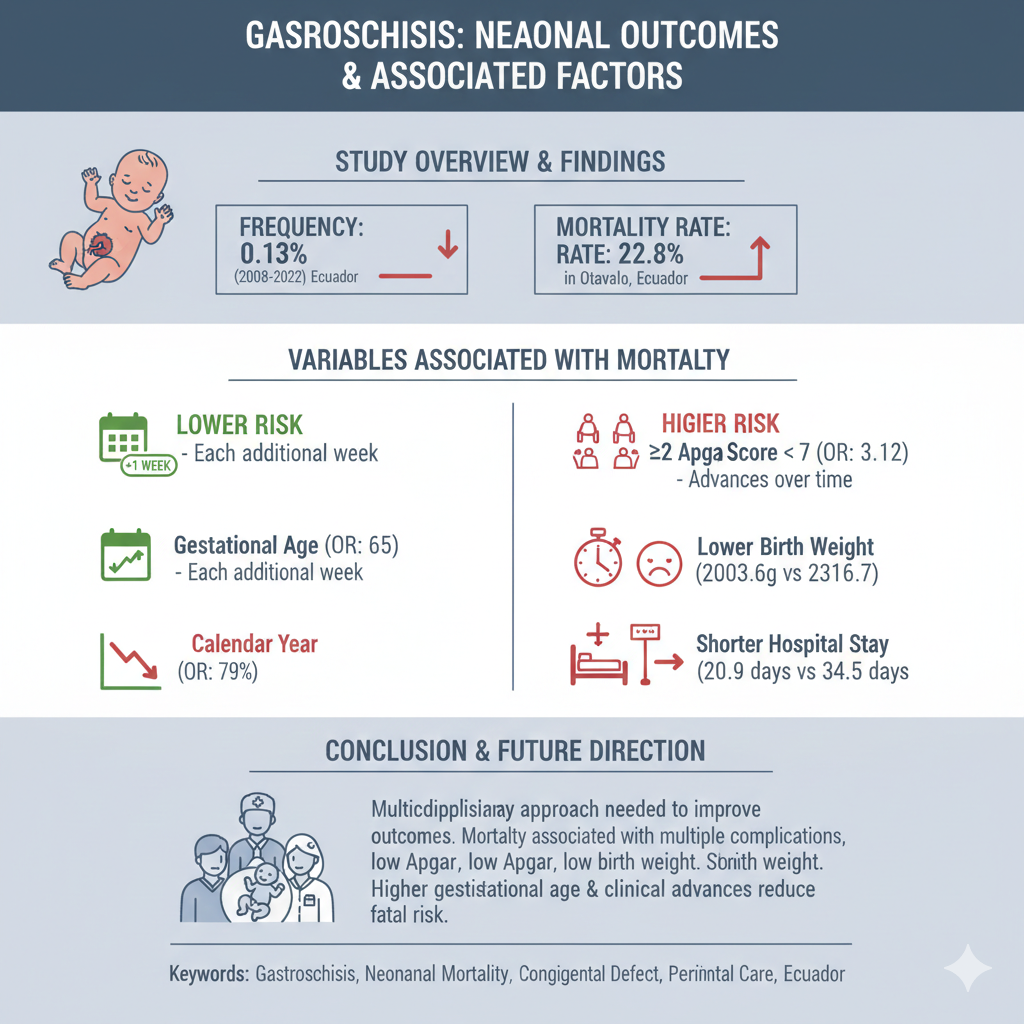
La gastroschisis es un defecto congénito caracterizado por la protrusión de las vísceras abdominales a través de una abertura paraumbilical. Objetivo: Determinar la frecuencia de gastroschisis y describir las variables asociadas con la mortalidad neonatal. Pacientes y método: Estudio transversal basado en datos del Sistema de Información Perinatal del Hospital Gineco Obstétrico Isidro Ayora (2008-2022). Se analizaron las variables sociodemográficas, obstétricas y neonatales mediante pruebas bayesianas para la determinación de variables de contingencia, regresión logística y analógica de prueba t bayesiana. Resultados: Se incluyó un total de 175 neonatos (58,9% mujeres). La frecuencia de gastroschisis fue del 0,13% (IC 95%: 0,11-0,15), con una tasa de mortalidad del 22,8%.
Hubo una asociación negativa con la edad gestacional (OR: 0,65; IC 95%: 0,49-0,85) y el año natural (OR: 0,79; IC 95%: 0,68-0,91), lo que indica una menor mortalidad por cada semana adicional de gestación y a lo largo del tiempo. La presencia de 2 complicaciones (OR: 3,46; IC 95%: 1,30-7,12) y el puntaje de Apgar < 7 a los cinco minutos (OR: 3,12; IC 95%: 1,01-60,91) se asociaron positivamente con mortalidad. Los neonatos fallecidos tenían menor peso al nacer (2.003,6g frente a 2.316,7g; BF10=35,2) y una estancia hospitalaria más corta (20,9 días frente a 34,5 días; BF10=204).
Conclusiones: La gastroschisis mostró una alta frecuencia, con mortalidad asociada a múltiples complicaciones, bajas puntuaciones de Apgar y bajo peso al nacer, mientras que una edad gestacional más alta y avances en el manejo clínico a lo largo de los años se asociaron con un menor riesgo fatal. Se hace hincapié en la necesidad de un enfoque multidisciplinario para mejorar los resultados neonatales en esta población.